
#6: How I Used the Ikigai Method to Find a Career I Actually Love
Finding Work You Love (and That Loves You Back)

Figuring out your next move?
Clarity doesn’t come from overthinking — it comes from action.
Last time, we talked about career audits — how to break down your skills, spot opportunities, and make more intentional career moves.
But skills alone aren’t enough.
A meaningful career isn’t just about what you’re good at. It’s about what excites you, serves others, and sustains you financially.
So how do you figure out what that looks like for you?
🛑 Finding this helpful? Subscribe for more career pivot insights every week!
Finding Ikigai
A few years ago, I found myself staring at spreadsheets filled with process calculations, wondering: Is this really it?
I had spent years studying engineering and landed a well-paying job — one that made sense on paper. But deep down, something was missing.
Every morning, I dragged myself to the office, moving in sync with other workers like we were on autopilot.
You know that Taylor Swift music video for “Ours”, where she’s stuck in a dull, gray office with lifeless coworkers, counting the hours until she can leave?
That was me.
I felt stuck. Hopeless. Like my life wasn’t my own.
Is this all there is? I wondered.

What is Ikigai?
One day, while doomscrolling career advice, I stumbled upon a Japanese concept called Ikigai, which translates to "reason for being."
It was the first time I saw a framework that explained why my career felt off-balance.
It’s based on four overlapping elements:
✅ What you love (passion)
✅ What you’re good at (strengths)
✅ What the world needs (purpose)
✅ What you can be paid for (market demand)
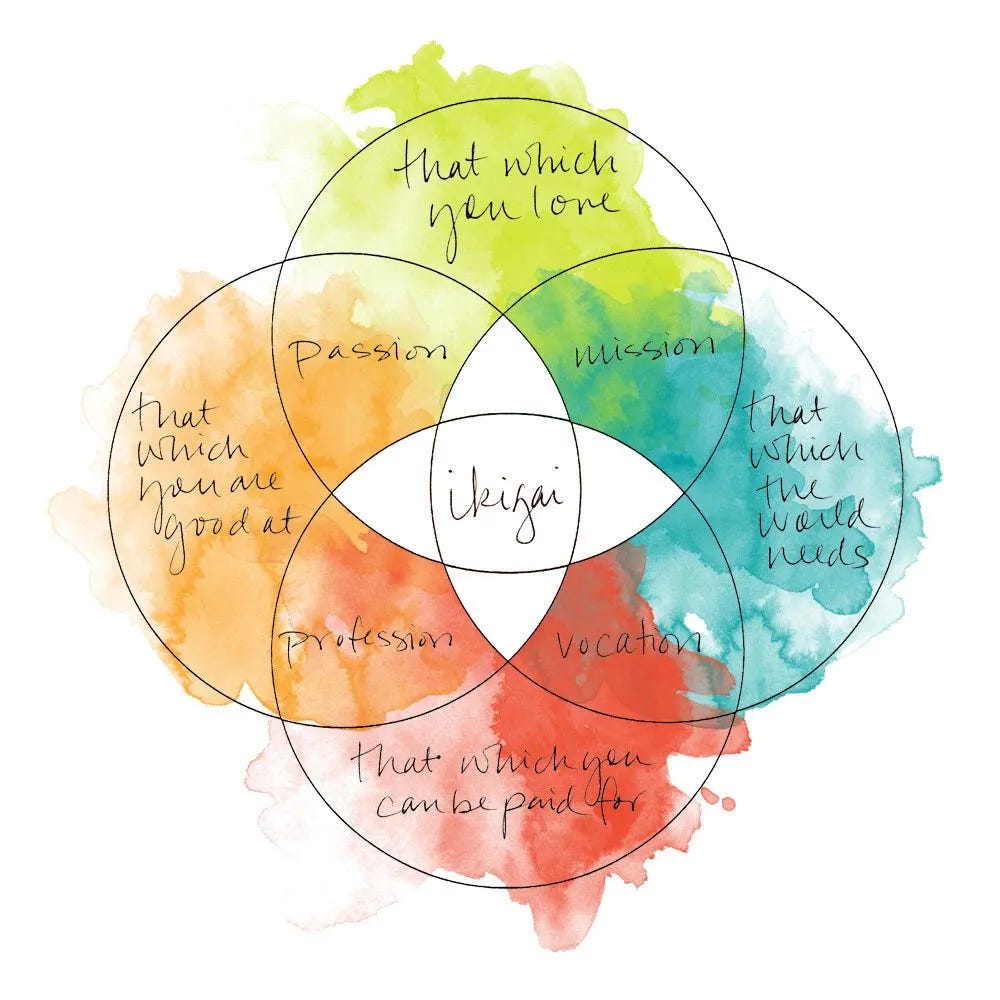

After I learned about the concept of Ikigai, I finally realized why my job felt off-balance.
My career checked the "skills" and "income" boxes, but it lacked passion and deeper purpose.
Good thing I had been experimenting — freelancing, writing on the side, and exploring different ways to use my skills.
Eventually, I found a path that aligned all four in writing.
🔗 Enjoying this breakdown? Share this with a friend who needs clarity on their career path!
How to Use the Ikigai Framework for Your Career Pivot
If you’re feeling stuck or unsure about your next move, here’s how to use Ikigai to gain clarity:
1️⃣ Reflect on What You Love
Think about the activities, topics, or tasks that make you lose track of time. These are clues to your passion.
For me, among these activites were writing and research. I could spend up to 4 hours in a deep dive when something interests me!
💡 Example: Do you get excited about breaking down complex ideas? Love organizing and planning? Do you find yourself naturally taking the lead in group projects?
📝 Action Step: Look at your daily routine and past experiences. What are three activities you do purely for the joy of it? Write them down—even if they don’t seem “career-worthy” yet.
2️⃣ Identify What You’re Good At
What are your natural strengths? (aka the skills that feel effortless to you but difficult for others.)
If you pay attention, you’ll find signals.
One time, a friend told me, “Don’t you know you’re naturally good at storytelling? Like I always look forward to your (Instagram) Stories!”
At family gatherings, my cousins and aunts always tell me they love my Facebook posts. My mom has even received messages from relatives saying how much they enjoy my writing.
For a long time, I brushed it off. I wasn’t trying to “be a writer” in those moments — I was just expressing myself.
But over time, I realized that what felt natural to me was something others valued.
💡 Example: What do people come to you with help for? Are you the go-to person for proofreading, organizing, or problem-solving?
📝 Action Step: Look at past feedback. What do people always compliment you on? What skills have you been recognized for at work or in casual settings? Write down 3-5 strengths.
💡 Finding this helpful? Subscribe to get more career pivot insights every week!
3️⃣ Find What the World Needs
What problems exist in the world that you care about solving? This helps you find purpose.
For me, I started noticing content that was missing information I was looking for. Or I would look at posts that could be better improved, content that could better connect, or find stories or new angles in places where others didn’t think there could be one.
Friends would ask me how they could better position themselves online.
At first, I didn’t think much of it.
But every time someone said, “I don’t know how to say this” or “I wish I could explain it like you do,” I realized — maybe this is something I can help with.
💡 Example: Do people ask for your advice on a specific topic? Are there recurring challenges you notice in your industry?
📝 Action Step: List 2-3 issues that frustrate or inspire you. What change do you wish to see?
4️⃣ Look for Market Demand
Passion alone won’t pay the bills — that’s why you need to find where your skills and interests intersect with demand.
I used to just write for fun, but in college, my friend (and then-roommate) Heidi opened my eyes to the possibility of getting paid for it.
At the time, I was tutoring for extra allowance, but that meant traveling to my tutees' houses after class. Meanwhile, Heidi was earning from our dorm room, writing content for businesses.
That’s when it clicked: what I did naturally as a hobby could actually sustain me.
The key difference between a passion project and a profitable career is finding where your skills solve a valuable problem.
💡 Example: Are companies hiring for this skill? Do people already pay for what you can do?
📝 Action Step: Research job listings, freelance gigs, or business models related to your strengths. Where do they overlap with market needs?
Final Thoughts: You Don’t Have to Choose Between Passion and Pay
A lot of people think they have to choose between stability and passion. But the truth is, you can build a career that aligns with both.
Ikigai isn’t about picking one over the other — it’s about finding where they meet.
Start small. Experiment. Follow your curiosity.
Clarity comes from action, not overthinking. Take the first step, and the path will unfold.
💬 Let’s Talk!
Which Ikigai element do you struggle with most? Hit reply and tell me—I’d love to hear!
📩 Enjoying Pivot & Prosper? Subscribe so you don’t miss next week’s edition!
🔗 Share this with a friend who’s figuring out their next career move!